

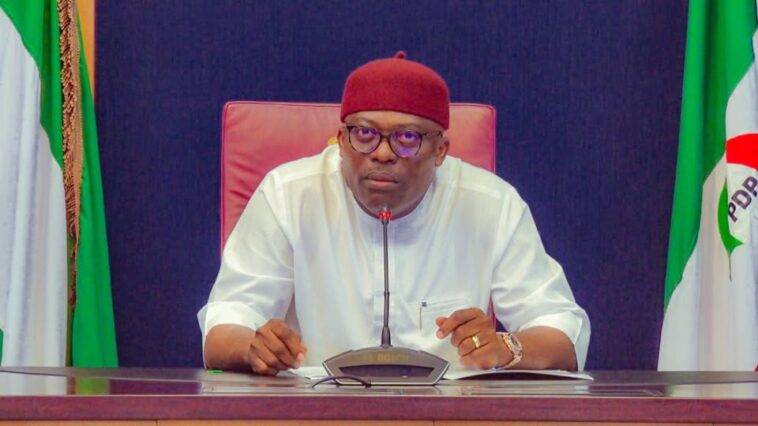
Rivers State Governor, Siminalayi Fubara, has raised the alarm over a ‘Federal Certificate of Occupancy’, allegedly produced by the Office of the Surveyor-General of the Federation, which he said poses a threat to the state.
The governor also said it runs contrary to Section 1 of the Land Use Act Cap L5 LFN 2004, which vests all land in a state in the governor as trustee.
Fubara stated this while speaking as Special Guest at the 4th Annual National Conference/Retreat of the Association of Private Practising Surveyors of Nigeria, a subgroup of the Nigerian Institution of Surveyors, held in Port Harcourt, the state capital, on Thursday.
He said, “The theme of this year’s conference, ‘Mapping the Future: The Vital Roles of Surveyors in the Nigerian Oil and Gas Industry,’ is important to us as a government because Rivers State is a major hub for oil refining, exploration, and production.
“Also, the input of surveyors in providing precise and identifiable sites and pathways through a scientific process of determining the relative positions of points on, above, or beneath the Earth’s surface through precise measurement of distances, angles, and elevations, and the collation of the information as data to produce survey plans, maps, and spatial records.”
The governor called for adequate protection of green areas and marine protected areas, as well as the need to protect forests during oil exploration surveys.
“The threat to land ownership and title in Rivers State by the production and issuance of ‘Federal Certificate of Occupancy’, allegedly issued by the Office of the Surveyor-General of the Federation and other affiliated Federal MDAs to claim land and waterways in Rivers State, is contrary to Section 1 of the Land Use Act Cap L5 LFN 2004, which vests all land in a state in the governor as trustee,” he said.
He emphasised the importance of “protection of the environment in planning by considering green areas, creation of marine protected areas, and protecting and preserving forests during oil exploration surveys by minimising the physical footprint of seismic operations, employing ‘green’ technologies, conducting thorough Environmental Impact Assessments, and implementing rapid restoration of affected areas.”
Fubara, however, commended the APPSN’s choice of Port Harcourt as the venue for its 4th annual conference, describing it as an affirmation that Rivers State is peaceful, welcoming, and a destination for investment and collaboration.
He emphasised that the state is the hub of the oil and gas industry in Nigeria and indeed the West African sub-region.
Fubara pointed out that the role of surveyors in governance is pivotal to growth, development, peace, and order in society, particularly as it concerns land use and management, provision of infrastructure, environmental management, and conflict resolution.
“Therefore, whatever is done in furtherance of these activities, such as the acquisition of Rights of Way and seismic operations, will impact either positively or negatively on the peace and development of the state.
“However, we have concerns bothering on the following: the threat to land ownership and title in Rivers State by the production and issuance of ‘Federal Certificate of Occupancy’, allegedly issued by the Office of the Surveyor-General of the Federation and other affiliated Federal MDAs to claim land and waterways in Rivers State contrary to Section 1 of the Land Use Act Cap L5 LFN 2004, which vests all land in a state in the governor as trustee.
“Secondly, land grabbing through the procurement of illegal survey plans and the superimposition of survey pillars and numbers. Thirdly, payment of adequate compensation to landowners by licence holders.
“We seek your intervention in this regard, considering current economic realities.”
He continued, “Fourth, but not the least, protection of the environment in planning by considering green areas, creation of marine protected areas, and protecting and preserving forests during oil exploration surveys by minimising the physical footprint of seismic operations, employing ‘green’ technologies, conducting thorough Environmental Impact Assessments, and implementing rapid restoration of affected areas.
“The government of Rivers State is not in doubt that the purpose of this conference and its theme is to provide a platform for the cross-fertilisation of ideas geared towards enhancing professional capacity, service delivery, and adoption of best practices in Nigeria, particularly in the oil and gas sector.”
Speaking, the National Chairman of APPSN, Simepreye Kalio, said the association, as a subgroup of NIS, is “strategically and divinely positioned to play unique complementary roles with other subgroups in the affairs and activities of the mother body, NIS.”
He added that such complementary roles “are vital for the survival of our surveying profession.”
On his part, Andy Nwikinane, Rivers State Chairman of APPSN, said without accurate geospatial data, reliable mapping systems, hydrographic surveys, engineering positioning, and land administration frameworks, the oil and gas industry cannot function effectively or sustainably.
Nwikinane noted that in upstream operations, surveyors support self-management while positioning offshore platforms, installations, and pipeline routes.
“In midstream and downstream sectors, we ensure precise alignment of pipelines, tank pumps, refineries, and distribution networks. Our contributions reduce risks, enhance safety, improve cost efficiency, and ensure regulatory compliance.
“Furthermore, in this era of digital transformation, surveyors are embracing emerging technologies such as geographic information systems, remote sensing, drone mapping, LIDAR, real-time GPS positioning, and digital mapping. These innovations are defining how assets are being managed and monitored in the oil and gas industry,” he stated.
President of the Nigerian Institution of Surveyors, Pius Eze urged participants to use the opportunity of the retreat for professional upgrading and networking.
