

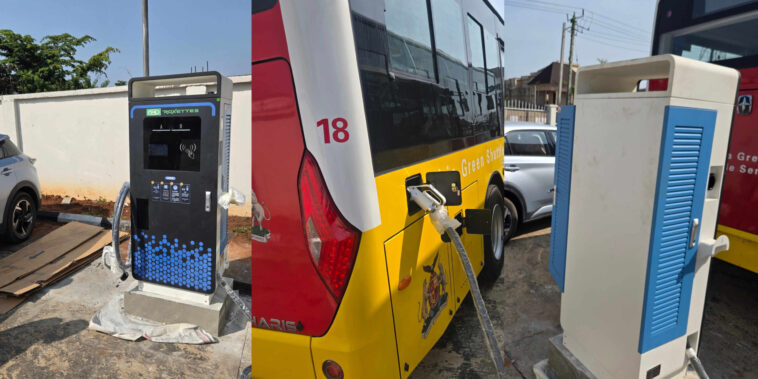
Abia State has taken a major leap toward sustainable transportation with the commissioning of ROXETTES Direct Current (DC) Charging Stations to power its growing electric bus fleet, becoming the first state in the South-East to establish a government-owned electric vehicle (EV) charging station. The landmark project, commissioned by Governor Alex Otti, represents a bold step in the state’s transition to clean mobility and signals Abia’s readiness to embrace innovation-driven development. The charging stations, strategically located in Umuahia, are designed to support the state-owned electric buses currently deployed for public transportation.
Speaking at the commissioning ceremony, government officials described the initiative as a clear demonstration of Abia State’s commitment to environmental sustainability, modern infrastructure, and forward-looking governance. The move, they noted, aligns with global efforts to reduce carbon emissions and transition away from fossil fuel–dependent transport systems.
The introduction of publicly accessible EV charging infrastructure is expected to significantly boost confidence in electric vehicle adoption among residents and private operators. Until now, the lack of charging facilities has been one of the biggest barriers to EV use in Nigeria. With the ROXETTES DC Charging Stations now operational, Abians and commuters in Umuahia and surrounding areas have tangible proof that electric mobility is no longer a distant concept but a practical and supported reality.
“This project lays the groundwork for a greener urban transport ecosystem in Abia State,” a senior government official said. “It reduces harmful emissions, lowers long-term operating costs for public transport, and positions Abia as a leader in sustainable mobility within the region.” The electric buses, powered by the newly commissioned charging stations, are expected to offer a cleaner, quieter, and more cost-effective alternative to conventional diesel-powered vehicles.
Beyond environmental benefits, the initiative is projected to deliver economic gains through reduced fuel expenses, lower maintenance costs, and the creation of new technical and operational jobs linked to EV infrastructure and maintenance.
Residents who attended the commissioning expressed optimism that the project would improve the quality of public transportation while contributing to cleaner air in the state capital. Environmental advocates have also praised the development, describing it as a timely intervention in the face of climate change and rising urban pollution. By taking the lead in establishing government-owned EV charging infrastructure in the South-East,
Abia State is positioning itself as a model for other states seeking to modernise their transport systems. Analysts say the initiative could encourage private investment in electric mobility, including the expansion of charging networks and the introduction of more electric vehicles for commercial and private use.
As Nigeria continues to explore pathways toward sustainable development, Abia’s investment in electric transport infrastructure underscores the role subnational governments can play in driving innovation. With the commissioning of the ROXETTES DC Charging Stations, the state has sent a strong message that clean, future-ready mobility is not only possible but already taking shape.
