
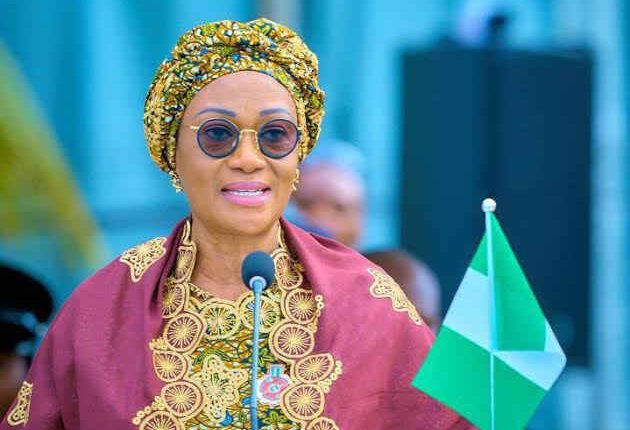
Nigeria’s First Lady, Senator Oluremi Tinubu, has openly called for increased United States military strikes against terrorist and bandit groups operating in northern Nigeria.
Speaking during an interview with Fox News while on an official visit to the United States, Mrs. Tinubu described the Christmas Day airstrikes ordered by U.S. President Donald Trump as “a blessing” for Nigeria.
Mrs. Tinubu made the comments on Friday, just a day after she attended the U.S. National Prayer Breakfast in Washington, an event hosted by President Trump and attended by political, religious, and diplomatic figures from across the world. During the Fox News interview, the First Lady stressed the need for deeper security cooperation between Nigeria and the United States, particularly in the fight against terrorism and armed banditry that has ravaged large parts of northern Nigeria for more than a decade.
“Nigeria is looking forward to collaboration,” she said. “We are expecting that there will be more.”
When asked specifically about the U.S. military strikes carried out on Christmas Day against terrorist targets in Sokoto State, Mrs. Tinubu did not hesitate in her response. “It was quite a blessing,” she said, a statement that immediately set off debates about sovereignty, civilian safety, and the broader implications of foreign military intervention on Nigerian soil.
The Christmas Day strikes marked a significant turning point in Nigeria–U.S. relations, as they represented the first publicly acknowledged kinetic military action by the United States within Nigeria’s borders. President Trump announced the operation in a dramatic late-night post on his Truth Social platform, stating that the strikes targeted ISIS-linked militants in north-western Nigeria who, according to him, had been “viciously killing, primarily, innocent Christians.”
“Tonight, at my direction as Commander in Chief, the United States launched a powerful and deadly strike against ISIS Terrorist Scum in North-West Nigeria,” Mr. Trump wrote. “They have been targeting and viciously killing, primarily, innocent Christians, at levels not seen for many years, and even centuries!”
The U.S. president went further to frame the strikes as both a warning and a promise, vowing sustained military action if attacks on Christian communities continued. “I’d love to make it a one-time strike,” Mr. Trump said earlier in January. “But if they continue to kill Christians, it will be a many-time strike.”
Mr. Trump later described the airstrikes as a “gift,” a characterization that aligns with Mrs. Tinubu’s own description of the operation as a blessing. He praised what he called the flawless execution of the mission, adding, “The Department of War executed numerous perfect strikes, as only the United States is capable of doing. Under my leadership, our Country will not allow Radical Islamic Terrorism to prosper.”
The announcement of the Christmas Day strikes came just days after reports emerged that the U.S. government had been conducting intelligence-gathering flights over Nigerian airspace since November. Those flights reportedly intensified after Mr. Trump publicly threatened military action against Nigeria, warning that the United States would intervene directly if attacks on Christians by terrorist groups did not stop.
Mrs. Tinubu’s comments have drawn particular attention because of the sensitive diplomatic and political context in which they were made. Relations between President Bola Tinubu’s administration and Washington have experienced turbulence in recent years. President Trump had previously described Nigeria as “a disgrace” under Tinubu’s leadership in remarks made in 2025, comments that reportedly strained ties between both governments.
In the months that followed those remarks, reports surfaced that the Nigerian government spent millions of dollars on Republican lobbyists in Washington in an effort to rehabilitate President Tinubu’s image and rebuild goodwill within Trump’s political circle. It was against this backdrop that Mr. Trump publicly showered praise on Mrs. Tinubu during the National Prayer Breakfast, lauding her presence and role, a moment that many analysts interpreted as a sign of warming relations.
However, back in Nigeria, Mrs. Tinubu’s endorsement of foreign military strikes has reignited long-standing debates about national sovereignty and the effectiveness of Nigeria’s own security architecture. Critics argue that welcoming U.S. airstrikes sets a dangerous precedent and raises questions about the capacity of Nigerian security forces to handle internal threats without external intervention.
Human rights advocates have also expressed concern about the potential for civilian casualties and the lack of transparency surrounding the Christmas Day operation. While U.S. officials have not released detailed casualty figures or precise locations of the strikes, local residents and civil society groups have called for independent investigations to ensure that civilians were not harmed.
Others, however, see the First Lady’s remarks as a reflection of growing frustration within the Nigerian political elite over the persistent insecurity in the north. Terrorist groups, bandits, and armed militias have carried out mass kidnappings, village raids, and religiously motivated attacks for years, often overwhelming local security forces and leaving communities vulnerable.
Supporters of stronger U.S. involvement argue that advanced American intelligence and airpower could significantly weaken terrorist networks that have proven resilient despite repeated Nigerian military operations. For this camp, Mrs. Tinubu’s comments signal a pragmatic approach to a crisis that has claimed thousands of lives and displaced millions.
Still, the framing of the strikes as a “blessing” has unsettled many Nigerians, particularly given the religious and ethnic sensitivities surrounding the conflict. Analysts warn that such language could inflame tensions, deepen perceptions of bias, and complicate efforts at national unity in a country already divided along regional and religious lines.
As debates continue, neither the Nigerian presidency nor the Ministry of Defence has issued a detailed public statement clarifying the government’s official position on the U.S. strikes or on Mrs. Tinubu’s remarks. The silence has only fueled speculation about whether Abuja formally approved the operation or whether it was carried out unilaterally by Washington.
What is clear is that Mrs. Tinubu’s comments have thrust Nigeria’s security crisis onto the global stage once again, raising difficult questions about foreign intervention, domestic accountability, and the future of counterterrorism efforts in West Africa. Whether the call for “more” U.S. strikes will translate into sustained military cooperation—or provoke diplomatic and political backlash—remains to be

seen.
