

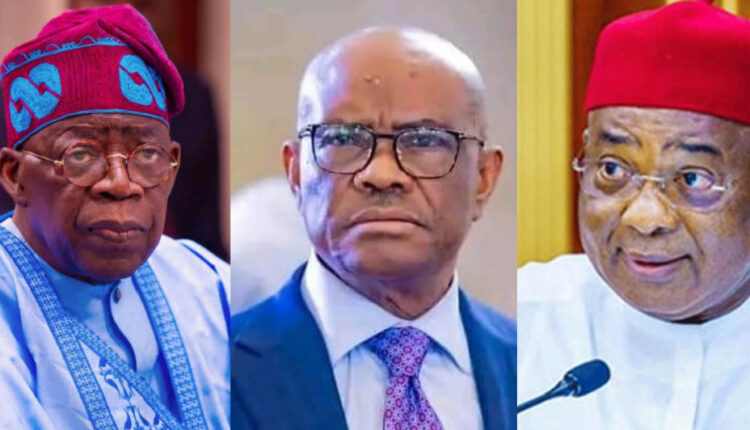
Governor Uzodinma, who also serves as Chairman of the Progressive Governors Forum (PGF), was initially appointed to head the powerful convention coordination committee, a body tasked with overseeing planning, logistics, consensus-building, and political negotiations for the APC’s national convention
President Bola Ahmed Tinubu has approved a major reshuffle within the All Progressives Congress (APC) ahead of the party’s crucial 2026 National Convention, removing Imo State Governor, Hope Uzodinma, as Chairman of the National Convention Coordination Committee and replacing him with former Speaker of the House of Representatives, Hon. Bello Masari.
The move, widely seen as strategic, signals a recalibration of internal party dynamics as the ruling party prepares for a convention that could shape its leadership structure and electoral outlook ahead of the 2027 general elections.
Governor Uzodinma, who also serves as Chairman of the Progressive Governors Forum (PGF), was initially appointed to head the powerful convention coordination committee, a body tasked with overseeing planning, logistics, consensus-building, and political negotiations for the APC’s national convention. However, under the new arrangement approved by President Tinubu, Uzodinma has been reassigned to serve as Treasurer of the Convention Planning Committee, a role that, while still important, places him in a less visible leadership position.
Hon. Bello Masari, a former Speaker of the House of Representatives and a seasoned party stalwart with deep roots in the APC’s predecessor structures, has now been named Chairman of the Convention Coordination Committee. Party insiders say Masari’s selection reflects President Tinubu’s desire to inject broader experience, balance, and perceived neutrality into the sensitive process of convention planning, especially at a time when internal alignments and ambitions are beginning to crystallize.
According to findings the decision to replace Governor Uzodinma was driven by a need to promote inclusiveness and unity within the APC. The party leadership is reportedly keen to avoid perceptions of dominance by any particular bloc or group, particularly governors, as the convention approaches. By appointing Masari, who is not a serving governor but remains influential across multiple party factions, the presidency appears to be signaling a deliberate effort to reassure various interests within the APC that the convention process will be fair and broadly representative.
Beyond the leadership reshuffle, President Tinubu also approved a significant expansion of the Convention Planning Committee. The membership of the committee has been increased from 73 to 90, an adjustment that party sources say is intended to accommodate more stakeholders and reflect the APC’s diverse political, regional, and ideological composition. The expansion has brought in several prominent figures, including Senator Barry Mpigi and Senator Ibrahim Oloriegbe, alongside other top party chieftains.
The inclusion of Senator Barry Mpigi has particularly drawn attention within political circles. Mpigi, who represents Rivers South-East Senatorial District, is widely regarded as a close political ally of the Minister of the Federal Capital Territory (FCT), Nyesom Wike. Wike, a former governor of Rivers State and a key figure in the opposition Peoples Democratic Party (PDP) before his appointment into Tinubu’s cabinet, has continued to play an influential role in Nigeria’s political landscape. Mpigi’s addition to the convention committee is being interpreted by many observers as another signal of Tinubu’s broad-based political approach and his willingness to accommodate figures linked to different power centres.
Although Wike remains a controversial figure within some APC circles due to his political history, his alliance with President Tinubu during and after the 2023 elections has positioned him as a critical bridge between competing interests. The inclusion of Mpigi, his close ally, is therefore seen as a calculated move aimed at consolidating support, particularly in the South-South region, where political loyalties remain fluid and highly strategic for national elections.
Senator Ibrahim Oloriegbe, another notable addition to the expanded committee, brings a different kind of experience to the table. Oloriegbe represented Kwara Central in the 9th Senate and currently serves as Chairman of the Governing Board of the National Health Insurance Authority (NHIA). His legislative background and involvement in public sector governance are expected to add institutional depth and policy-oriented perspectives to the committee’s work.
Within the APC, reactions to the reshuffle have been mixed but largely measured. Some party members view the removal of Governor Uzodinma as a demotion, especially given his status as Chairman of the Progressive Governors Forum and his visible role in party affairs. Others, however, argue that his reassignment to treasurer still places him at the heart of convention planning and reflects the president’s intention to balance power rather than sideline influential figures.
Supporters of the move argue that Tinubu is being proactive in managing internal party tensions early, rather than allowing grievances to fester closer to the convention. By broadening the committee and redistributing roles, the president may be seeking to ensure that no single individual or group can claim undue influence over the convention process, which will be critical in determining the party’s national leadership and strategic direction.
Political analysts note that the APC’s 2026 National Convention is not just a routine party gathering but a pivotal event that will set the tone for the run-up to the 2027 elections. Decisions taken at the convention could affect candidate selection processes, internal zoning arrangements, and the overall cohesion of the party at a time when economic challenges and security concerns continue to shape public opinion.
President Tinubu’s hands-on involvement in reshaping the convention committee underscores the importance he attaches to party unity and internal stability. Since assuming office, Tinubu has consistently emphasized the need to keep the APC united despite ideological differences, personal ambitions, and regional interests. The latest reshuffle appears to align with that broader strategy.
As preparations for the 2026 convention gather momentum, attention will likely remain focused on how the expanded committee operates and whether it succeeds in delivering a transparent and inclusive process.
For now, the removal of Governor Hope Uzodinma as chairman, the appointment of Bello Masari, and the inclusion of figures linked to powerful political actors like Nyesom Wike all point to a carefully calibrated effort by President Tinubu to manage the APC’s complex internal dynamics while keeping an eye firmly on the future.
