

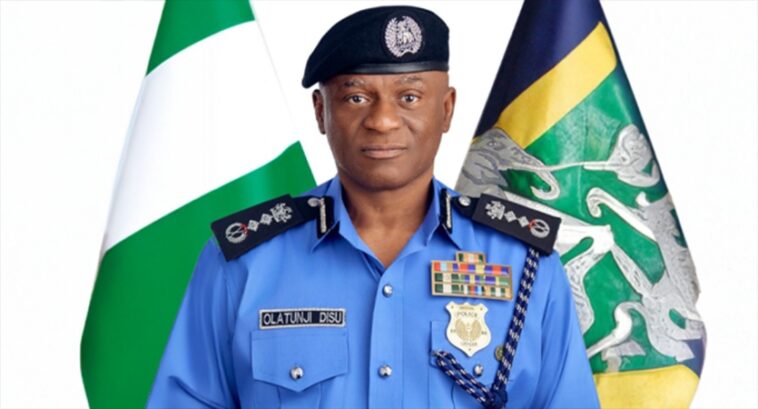
President Bola Tinubu has sworn Olatunji Disu in as the Inspector-General of Police (IGP).
The Disu took the oath of office at the Council Chamber of Presidential Villa, Abuja, shortly before the commencement of the Federal Executive Council (FEC) meeting on Wednesday.
The President also administered the oath of office to six commissioners of the Revenue Mobilisation Allocation and Fiscal Commission (RMAFC) and two from the Federal Civil Service Commission (FCSC).
The ceremonies were witnessed by ministers, senior government officials, and family members of the appointees.
The council meeting began shortly after the swearing-in ceremonies.
In attendance were Vice President Kashim Shettima; the Secretary to the Government of the Federation (SGF), Senator George Akume; the Chief of Staff to the President, Femi Gbajabiamila; the National Security Adviser (NSA), Nuhu Ribadu; and the Head of the Civil Service of the Federation, Mrs. Esther Walson-Jack.
Disu was appointed as the acting IGP on February 25, 2026, by Tinubu, following the resignation of former IGP Kayode Egbetokun.
His appointment was endorsed by the Nigeria Police Council (NPC).
The former Assistant Inspector-General assumed office last Wednesday.
He had previously served as AIG in charge of the Force Criminal Investigation Department (FCID) Annex, Alagbon, Lagos, after his promotion to the rank last year.
Disu, a former head of the Lagos Rapid Response Squad (RRS), has promised to provide an accountable, modern, and professional policing.
State Police
Among other responsibilities, Disu is expected to reposition the Nigeria Police Force and proffer workable solutions to the challenges facing policing in Nigeria.
On Wednesday, he inaugurated a committee on state police.
Speaking during his inaugural Conference with Senior Police Officers at the Peacekeeping Conference Centre,
He emphasised the importance of state police to the security of the country.
The IGP also told the committee that the task before them is “both significant and timely,” and one that would shape the “framework through which state policing may operate in Nigeria.” (Channels)
