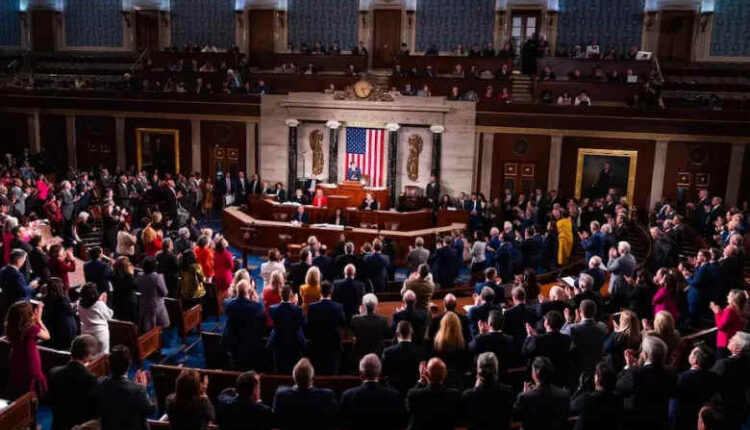
A group of United States lawmakers has introduced a new bill in the House of Representatives seeking closer collaboration between Washington and Abuja to counter what they describe as the destabilizing impact of illegal Chinese mining operations in Nigeria.
The proposed legislation, titled the ‘Nigeria Religious Freedom and Accountability Act of 2026‘, was introduced on Tuesday by five Republican members of Congress: Representatives Chris Smith, Riley Moore, Brian Mast, Mario Diaz-Balart, and Bill Huizenga. The bill combines concerns over religious freedom and regional security with allegations that certain foreign mining activities in Nigeria are contributing to militia violence.
At the heart of the proposal is a directive urging the US Secretary of State to work closely with the Nigerian government to address what lawmakers characterize as “hostile foreign exploitation” linked to illegal mining operations, particularly those allegedly involving Chinese nationals.
Allegations of Protection Payments
The sponsors of the bill allege that some Chinese mining companies operating in Nigeria have been paying protection money to Fulani militias in order to secure access to mineral-rich territories. According to the lawmakers, such payments have fueled insecurity in parts of the country already grappling with banditry, communal violence, and insurgent activity.
While the bill does not name specific companies, it claims that these alleged financial arrangements have strengthened armed groups operating in northern Nigeria, contributing to local instability and undermining national security efforts.
Clauses 10 and 11 of the bill are particularly explicit. They state:“The Secretary of State should work with the Government of Nigeria to counteract the hostile foreign exploitation of Chinese illegal mining operations and their destabilizing practice of paying protection money to Fulani militias.”
The legislation also instructs the Secretary of State to evaluate whether certain Fulani-ethnic militias meet the criteria to be designated as Foreign Terrorist Organizations (FTOs) under US law. Such a designation would carry significant implications, including sanctions, asset freezes, and criminal penalties for individuals or entities providing material support.
Security and Counter-Terrorism Cooperation
Beyond its focus on mining, the bill outlines a broader framework for US-Nigeria cooperation on security and religious freedom. It calls on the Secretary of State to provide technical support aimed at reducing and ultimately eliminating militia-related violence in Nigeria.
This support would include assistance with disarmament initiatives, intelligence sharing, and comprehensive counter-terrorism cooperation. The bill emphasizes strengthening Nigeria’s capacity to address armed groups operating in rural and mining-heavy regions, particularly in the northwest.
Lawmakers argue that instability in Nigeria—Africa’s largest economy and most populous nation—has implications beyond its borders. By linking foreign mining operations to militia activity, the sponsors frame the issue as not merely a domestic Nigerian problem but one with regional and global security consequences.
International Coordination
The proposed legislation also calls for coordination with key international partners, including France, Hungary, and the United Kingdom. According to the bill’s sponsors, such collaboration would help advance shared objectives related to religious freedom, governance reforms, and peacebuilding efforts in Nigeria.
The inclusion of European partners reflects the broader geopolitical dimension of the issue. Western governments have increasingly expressed concern about China’s growing economic footprint in Africa, particularly in sectors such as mining, infrastructure, and telecommunications.
Nigeria, rich in minerals including gold, lithium, tin, and columbite, has become an attractive destination for foreign investors. However, illegal mining has remained a persistent challenge, with authorities periodically cracking down on unauthorized operators and smuggling networks.
Reference to 2023 Investigative Report
In building their case, the lawmakers cite a 2023 investigative report by The Times, which alleged that Chinese nationals involved in Nigeria’s mining sector were indirectly funding militant groups in the country’s northwest.
According to that report, some miners in Zamfara State acted as intermediaries—described as “runners”—for armed groups, facilitating financial transactions that enabled militants to maintain control over mining territories. The report suggested that these arrangements raised concerns that “Beijing could be indirectly funding terror in Africa’s largest economy.”
Although the Chinese government has consistently denied supporting illicit activities abroad, critics argue that weak enforcement mechanisms and opaque business practices can create environments where such allegations flourish.
Potential Diplomatic and Economic Implications
If passed, the Nigeria Religious Freedom and Accountability Act of 2026 would represent a significant escalation in US scrutiny of foreign mining activities in Nigeria. It would also signal a more assertive American posture in addressing what it views as the intersection of economic exploitation and security threats in West Africa.
Analysts say the bill could have far-reaching diplomatic implications. For Nigeria, it underscores the delicate balancing act between attracting foreign investment and maintaining national security. China is one of Nigeria’s largest trading partners and a major investor in infrastructure projects. Any US-led effort to directly counter Chinese-linked operations could place Abuja in a challenging diplomatic position.
For Washington, the legislation aligns with a broader strategy of countering China’s influence in Africa. In recent years, US policymakers have increasingly framed China’s economic activities on the continent through the lens of strategic competition.
However, some observers caution that the allegations contained in the bill would need thorough verification and collaboration with Nigerian authorities to avoid unintended consequences. They note that Nigeria’s security challenges are complex and multifaceted, involving banditry, insurgency, communal conflicts, and socio-economic grievances that predate current foreign mining controversies.
Focus on Religious Freedom
In addition to security concerns, the bill incorporates provisions related to religious freedom, reflecting longstanding US congressional interest in sectarian violence in Nigeria. Lawmakers have previously debated whether Nigeria should be designated as a “Country of Particular Concern” under the US International Religious Freedom Act due to attacks on Christian communities and intercommunal clashes.
By combining issues of illegal mining, militia violence, and religious persecution, the proposed act attempts to create a comprehensive framework for US engagement with Nigeria on governance and human rights.
What Comes Next
The bill has been introduced in the House of Representatives and will need to pass through committee review before it can proceed to a full vote. Even if approved by the House, it must also pass the Senate and be signed into law by the President to take effect.
Should it become law, the Secretary of State would be required to develop and implement strategies in partnership with the Nigerian government, potentially reshaping aspects of US-Nigeria security cooperation.
For now, the legislation has sparked renewed attention on the complex relationship between foreign investment, local conflict, and national sovereignty in Nigeria’s mining sector. As debates unfold in Washington, Nigerian authorities and international stakeholders will be watching closely to see how the proposal evolves—and what it might mean for Africa’s largest economy and its ongoing struggle to secure its vast natural resources.