 adminreporter
President Bola Tinubu has signed the Electoral Act (Amendment) Bill 2026 into law, introducing fresh changes to Nigeria’s electoral framework just days after the 2027 general election timetable was unveiled.
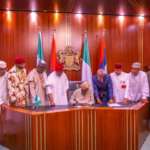
The signing ceremony took place at the Presidential Villa in Abuja at about 5:00 p.m. on Wednesday, in the presence of principal officers of the National Assembly. The amended bill had been passed by lawmakers on Tuesday.
The development follows the recent announcement of the 2027 election schedule by the Independent National Electoral Commission (INEC), formally setting the stage for political activities ahead of the nationwide polls.
He said the essence of democracy is to have very solid discussions committed to national development and nation-building, essential for the stability of the nation.
According to him, it is high time Nigerians had confidence in their system.
“It’s not as important as the history aspects of this. What is crucial is the fact that you manage the process to the extent there will be no confusion, no disenfranchisement of Nigerians, and that we are all going to see democracy flourish.
“No matter how good the system is, it’s managed by the people, promoted by the people, and the result is finalised by the people,” The President said.
‘We Need To Avoid Interference’
On the ongoing debates over the transmission of election results, Tinubu said, “In fact, for final results, you are not going to be talking to the computer; you are going to be talking to human beings who will announce the final results.
“And when you look at the crux of various arguments, maybe Nigerians should question our broadband capability. How technically are we today? How technically will we be tomorrow to answer the call of either real-time or not?
“And as long as you appear personally, as a manual voter in any polling booth, a ballot paper is given to you manually, you decide in a corner and thumbprint the passing of your choice, you cast your votes, without hindrance and any interference, ballots are subsequently counted manually, sorted, and counted manually.”
“It’s just the arithmetic accuracy that is to enter into Form EC8A. It’s the manual, essentially. The transmission of that manual result is what we’re looking at.
“And we need to avoid glitches — I’m glad you did — interference, unnecessary hacking in this age of computer inquisitiveness.
“Nigeria will be there. We will flourish. We will continue to nurture this democracy for the fulfillment of our dream for the prosperity and stability of our country,” the President added.
Heated Conversations
The bill has generated heated debates in the last one week, with lawmakers and prominent Nigerians disagreeing over the method for the transmission of results, ahead of the 2027 general elections.
The Senate had on Tuesday passed the Electoral Act, 2022 (Repeal and Re-Enactment) Bill 2026 but not without a rowdy session as the upper chamber resumed proceedings with a demand for division over Clause 60 raised by Senator Enyinnaya Abaribe (ADC/Abia South).
The Senate President, Godswill Akpabio, had stated that he believed the demand had previously been withdrawn, but several opposition senators immediately objected to that claim.
Citing Order 52(6), the Deputy Senate President, Barau Jibrin, argued that it would be out of order to revisit any provision on which the Senate President had already ruled.
This submission sparked another uproar in the chamber, during which Senator Sunday Karimi had a brief face-off with Abaribe.
The Senate Leader, Opeyemi Bamidele, then reminded lawmakers that he had sponsored the motion for rescission, underscoring that decisions previously taken by the Senate are no longer valid.
He maintained that, consistent with his motion, Senator Abaribe’s demand was in line.
Akpabio further suggested that the call for division was merely an attempt by Senator Abaribe to publicly demonstrate his stance to Nigerians.
The senate president sustained the point of order, after which Abaribe rose in protest and was urged to formally move his motion.
Rising under Order 72(1), Abaribe called for a division on Clause 60(3), specifically concerning the provision that if electronic transmission of results fails, Form EC8A should not serve as the sole basis, calling for the removal of the proviso that allows for manual transmission of results in the event of network failure.
During the division, Akpabio directed senators who supported the caveat to stand.
He then asked those opposed to the caveat to rise.
Fifteen opposition senators stood in opposition.
However, when the votes were counted, the Senate President announced that 15 senators were not in support of the proviso, while 55 senators voted in support of it.
Clause-By-Clause Consideration
Earlier, proceedings in the Senate were momentarily stalled as lawmakers began clause-by-clause consideration of the Electoral Act, 2022 (Repeal and Re-Enactment) Bill 2026, following a motion to rescind the earlier amendment.
The motion to rescind the bill was formally seconded on Tuesday, paving the way for the upper chamber to dissolve into the committee of the whole for detailed reconsideration and reenactment of the proposed legislation.
During the session, the Senate President, Godswill Akpabio, reeled out the clauses one after the other for deliberation.
However, the process stalled when at clause 60, Senator Enyinnaya Abaribe (ADC/Abia South), raised a point of order, drawing immediate attention on the floor.
Following the intervention, murmurs spread across the chamber as lawmakers began speaking in small groups and approaching the Senate President’s desk for consultations.
The session immediately moved into a closed door session.