
 Ogona Anita
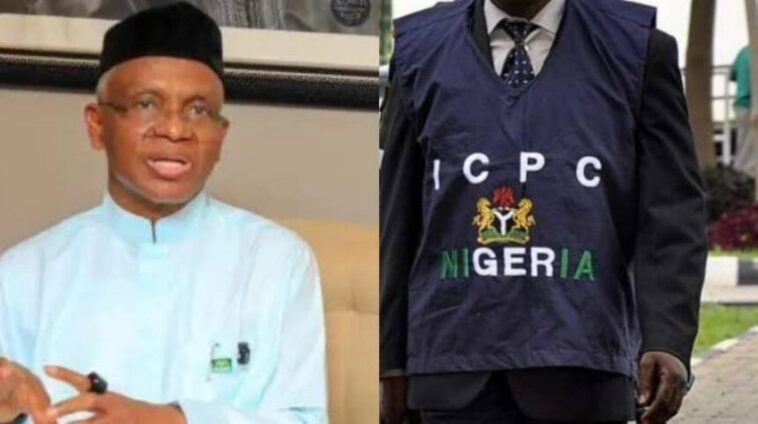
A month after the Independent Corrupt Practices and Other Related Offences Commission (ICPC) took the former governor of Kaduna State, Nasir El-Rufai into custody, he is yet to be arraigned in any court.
This is just as the Court of Appeal in Kaduna yesterday overturned the verdict of a High Court in Kaduna which dismissed El Rufai’s right to challenge the Kaduna State House of Assembly’s indictment for alleged corruption, reports Daily Trust.
El-Rufai had earlier spent two nights in the custody of the Economic and Financial Crimes Commission (EFCC) over alleged financial impropriety when he was governor before he was picked up by the Department of State Services and then the ICPC.
On February 16, the former governor honoured the invitation extended to him by the EFCC, where he was grilled by detectives of the commission.
This was after security operatives failed to arrest him at the Abuja airport when he returned from Egypt.
What transpired in court before
Lawyers said although the court can extend the remand, doing so without a court order violates Section 293- 296 of the Administration of the Criminal Justice Act (ACJA).
The ICPC had on February 19 obtained a 14-day remand order from a Chief Magistrate Court in Bwari, FCT to keep El Rufai, which was renewed.
However, El Rufai’s lawyers had filed a motion challenging the extension of the remand order for the ICPC, where they raised several grounds which were earlier fixed for ruling yesterday.
Magistrate Okechukwu Akweke is expected to rule on March 19.
In the motion before the magistrate court, El-Rufai alleged that officials of the ICPC asked him not to participate in politics as a condition for his release from detention, arguing that it was a violation of his constitutional rights.
According to the filing, he initially reported to the EFCC on February 16, and was granted bail, after which the DSS arrested him and later transferred him to ICPC without clear legal authority, leading to his unlawful detention.
The suit accused top officials, including the ICPC chairman and DSS Director-General, of wrongful confinement and restraint. His legal team also argued that the remand order was invalid and that his detention exceeded the legal timeframe without proper justification.
In addition, El-Rufai claimed he was held incommunicado, denied access to family, lawyers, and medical care actions his lawyers say violate due process and personal liberty under Nigerian law.
We’re constrained by different litigations – ICPC
Speaking to one of our correspondents last night, a senior official at the ICPC, explained that multiple suits filed against the commission were delaying his arraignment in court.
He said all the injunctions against the ICPC must be vacated before the commission could arraign the former governor.
“El-Rufai is the one delaying his arraignment in court. He has filed different suits against the commission. So,
He said all the injunctions against the ICPC must be vacated before the commission could arraign the former governor.
“El-Rufai is the one delaying his arraignment in court. He has filed different suits against the commission. So, some of these suits need to be vacated before we can proceed legally,” the official said.
The spokesman of the ICPC, John Odey, in a statement yesterday, insisted that the custody status of El-Rufai remains legal.
He said it was the counsel to the former governor that requested a long adjournment date for some of the cases filed regarding El-Rufai’s extension order.
Odey said: “The Independent Corrupt Practices and Other Related Offences Commission (ICPC) wishes to clarify the current legal status of the remand in detention of the former Governor of Kaduna State, Mallam Nasir Ahmad El-Rufai.
This statement is necessary to correct inaccurate reports by some media outlets suggesting that the commission was in court today, 17th March 2026, seeking a fresh extension of his detention.
“The Commission appeared in court today for the hearing of Mallam El-Rufai’s application, dated and filed on 6th March 2026, which seeks to overturn the court order renewing his remand issued on 5th March 2026.
the rule of law.
Barrister Abba Hikima said while investigations into alleged crimes should be encouraged, suspects should not be detained for prolonged periods without being charged in court.
‘It is unfortunate that in a constitutional democracy like Nigeria, a suspect can be held for this number of days without being charged,’ he said.
Hikima stressed that investigations should precede arrests.
‘The law is clear that you don’t arrest someone and then start investigating. Investigation should come first before arrest and detention,’ he said.
Barrister Yusuf Ali Faragai said the constitution requires that anyone accused of committing an offence should be brought before a court within a short period, except where a valid detention order has been obtained.
The Chairperson of the Women Forum of the Nigerian Bar Association, Barrister Huwaila Muhammad Ibrahim, said investigating agencies are expected to present suspects before a court within 24 hours, except where the court grants an extension.
She said since the court had already given the ICPC two weeks to either charge or release the former governor, the commission should return to the court if it requires more time to conclude investigations.
‘It is for the investigating authority to go back to the court and explain why the time given is not sufficient for them to conclude the investigation,’ she said.
Salman Jawondo (SAN) said law enforcement agencies must strictly comply with constitutional provisions in detaining suspects during investigations.
He maintained that prolonged detention without court proceedings raises legal concerns.
“Generally speaking, they ought to have taken him to court because he has been detained for more than two weeks now. If they have reasons why he should not be granted bail, the court will consider them.
“Detention should not be punitive. We must create a level playing field when investigating crimes. Nobody should be too small or too big,’ he said.
Barrister Chibueze Maduka said, ‘In El Rufai’s case, the remand order obtained by ICPC on 19th February 2026 elapsed on 6th March 2026. From 6th March 2026, it is expected that El Rufai should be formally charged, released, or ICPC apply for an extension of the order. If they fail to do any of the three above, the continuous detention of El Rufai from 6th March 2026 is unlawful.’
Similarly, Abeny Mohammed (SAN) said detention orders obtained from court are renewable by the court upon an application by the EFCC or the ICPC.
On his part, Sam Ogala Esq, said the decision of the court to extend could depend on the circumstances of the case, if there is need for further investigation or where the defendant is not cooperating with the investigators.
E.M.D. Umukoro Esq said where there is a violation of fundamental rights, the court can remedy that if the defendant or detainees seek such.
“The defendant or a suspect can be lawfully detained or held in custody when the prosecuting agency is able to approach the court with facts and evidence to convince the court that such a person should be held in custody either as a result of inconclusive investigation, or that the individual is a flight risk or that the person or suspect can tamper with the evidence, or could be the seriousness of the offence.
“In any of these cases, the court is allowed to review, may give 30 days, review and another 30 days,” he said.
It was gathered that prominent Nigerians had intervened in the matter by urging President Bola Ahmed Tinubu, to ensure that El- Rufai is arraigned in court and the matter should follow the proper judicial process.
Similarly, Sheikh Ibrahim Magary, had also pleaded with leaders like former President Ibrahim Babangida to intervene.