 Ogona Anita
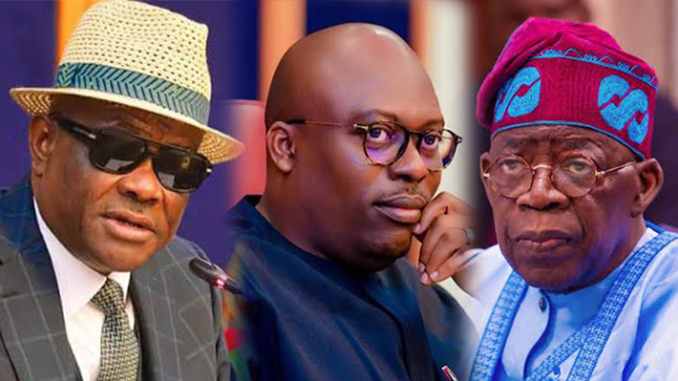
President Bola Tinubu has, again, intervened to halt the escalating feud between Rivers State Governor, Siminalayi Fubara, and his predecessor and estranged godfather, Nyesom Wike.
The peace deal came after months of failed settlements that had pushed the state to the brink of governorship impeachment, legislative paralysis, and prolonged instability.
The president had previously intervened in the rift between Fubara and Wike in December 2023, when he brokered a fragile peace, which broke down soon after, leading the declaration of a six-month emergency rule in the state on March 18, 2025 by Tinubu and suspension of the governor.
However, in the fresh push to defuse one of the country’s most combustible political disagreements in recent times, Tinubu ordered an immediate suspension of any impeachment moves against Fubara, but with very strict conditions.
Multiple highly placed sources familiar with the issue told THISDAY that Tinubu, who acted just before departing for an official trip to Türkiye on January 26, laid down the political terms aimed at restoring peace between the two key political actors in Rivers State, a state seen as critical to the president’s re-election in 2027.
Tinubu’s intervention came with a blunt message to Fubara: Wike remains the undisputed political leader of the party, whether APC or Peoples Democratic Party (PDP) in Rivers State, and he must be respected in that regard.
THISDAY was told that the president, visibly displeased by the depth of the rift, despite his efforts in the past, warned that continued hostilities would undermine governance in the state and lead to instability, a situation Tinubu said he was not ready to condone.
Tinubu was said to have clearly told Wike to back off any impeachment plots against Fubara and allow governance in the state.
Fubara and his predecessor, Wike, have had a cat and mouse relationship just within months of the governor’s swearing into office in May 2023. What is now out in the open is that Wike, who personally engineered Fubara’semergence as his successor, has sought to control the levers of power from Abuja, while the governor has resisted what many see as the FCT minister’s chokehold on him.
The relationship began to fracture within months of Fubara’s inauguration, as the governor quietly sought to assert his independence, with political actors in the state immediately taking sides. Notably, in the ongoing fight, almost all the state lawmakers align with Wike.
Subsequently, attempts to impeach Fubara emerged from the pro-Wike group in the House of Assembly. Although the governor has tried to wriggle out of the situation several times, the shadows of impeachment continue to haunt him every time there is a disagreement with the minister.
Several efforts have been made to resolve the crisis, all of which failed to produce lasting peace. The failure of one of the peace meetings eventually led to the declaration of a state of emergency in the oil-rich state, which lasted six months.
While Wike’s camp continues to accuse Fubara of betrayal and political ingratitude, the governor’s allies argue that Rivers State cannot be run from outside the state by a former governor now serving as the FCT minister.
Still on the latest attempt to seek an end to the prolonged imbroglio, one insider recounted the president’s thinking, drawing a parallel with Lagos State, where Sanwo-Olu is the leader of the party.
Tinubu was said to have stated, “Is Babajide Sanwo-Olu my leader in Lagos, or was Babatunde Fashola my leader when he was governor?”, according to a source.
The president was equally said to have stated that Fubara should respect elders, saying Wike is an elder statesman in Rivers politics and should be regarded as such. Tinubu, one of the sources added, made it clear that political seniority could not be wished away because of personal disagreements.
As part of the peace deal, the president directed Wike and his camp to immediately halt all impeachment-related actions against Fubara, citing his overriding concern about stability in Rivers State.
In return, Fubara was instructed to makesignificant concessions. Chief among them was the formal recognition of Wike as the “political leader” in Rivers State, with final authority on party matters.
Sources said Tinubu stressed that all internal party disputes in the state must ultimately defer to Wike.
However, the complexity of Wike’s case is that he is not a card-carrying member of APC in Rivers State. Officially, he remains a member of the struggling opposition PDP, although he is a top minister under the ruling APC government – A position he has used to weaken his party, the PDP.
Besides, the understanding covered the upcoming state House of Assembly bye-elections in Rivers State. Tinubu directed that candidates loyal to Wike should be recognised by the APC leadership for the two vacant assembly seats. “It was explicitly stated that Wike has two candidates for the by-elections and that those candidates are to be recognised by the APC party structure,” one source said.
Already, Independent National Electoral Commission (INEC) has fixed February 21, 2026 for the contentious by-elections into Ahoada East II and Khana II State Constituencies of the state.
THISDAY learnt that while the Ahoada-East II seat became vacant following the resignation of its former occupant, Edison Ehie, who was appointed Chief of Staff (CoS) to Governor Fubara, the Khana II seat was vacant since the death of its lawmaker, Dinebari Loolo, in September 2023.
Notably, the sensitive issue of Fubara’s second term ambition also came up for deliberation, the source said, but was deliberately side-lined, with the president alleged to have said such discussions were too early for now. One source said Tinubu described any talk about the 2027 governorship in the state as still premature.
Source: THISDAY