 Ogona Anita
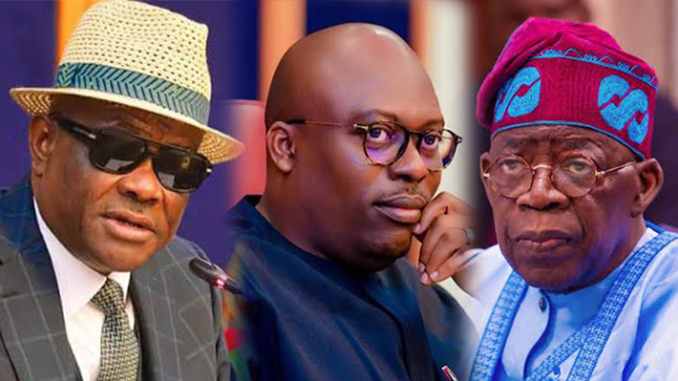
The Minister of the Federal Capital Territory (FCT), Nyesom Wike, has issued a stern warning to Rivers State Governor, Siminalayi Fubara, declaring that supporting President Bola Ahmed Tinubu would not automatically guarantee him a return ticket for a second term as governor.
Wike made the statement during a visit to Emohua Local Government Area of Rivers State, where he addressed his supporters in what many observers described as another strong signal in the ongoing political power tussle within the state. The former Rivers governor, known for his blunt political style, cautioned that loyalty to the President alone was not a substitute for political structure, agreements, and grassroots support.
According to Wike, political survival and electoral success depend on honouring agreements and maintaining alliances, not merely aligning with the federal government of the day. His remarks were widely interpreted as a direct message to Governor Fubara amid the deepening political rift between both camps. “
The minister also used the opportunity to lament what he described as sustained attacks and insults directed at him by political opponents. Speaking on Saturday at the country home of the Chairman of the South-South Development Commission (SSDC) and former Deputy Speaker of the House of Representatives, Chibudom Nwuche, in Ochigba community, Ahoada East Local Government Area, Wike said he had become one of the most vilified political figures in the country. The occasion was a thanksgiving service organised by Nwuche and his family, which attracted several political leaders from Ahoada East LGA and other parts of Rivers State. “I want you to know this: after President Bola Tinubu, the next most abused politician in Nigeria is me,” Wike declared.
He attributed the persistent attacks against him to his refusal to compromise on political agreements and his insistence on implementing decisions once consensus had been reached. “Why are they abusing me? Because they know agreement is agreement. When we have agreed on something, let’s implement it,” he said. Wike emphasised that his political philosophy was anchored on loyalty and consistency, stressing that he had never wavered in his support for President Tinubu, even when it was politically risky to do so.
Questions Over Tinubu’s “New Supporters” The minister also dismissed claims by some political actors who have recently portrayed themselves as long-standing supporters of President Tinubu. He argued that many of those now aligning publicly with the President were nowhere to be found during the crucial moments of the 2023 general elections. “Our support for Asiwaju Bola Ahmed Tinubu has remained stable,” Wike said. “Those who are now claiming to support him, where were they in 2023?” His comments appeared to be a direct jab at political figures in Rivers State and beyond who have since shifted allegiance to the ruling All Progressives Congress (APC) after Tinubu’s victory.
Nwuche Reaffirms Loyalty to Wike Earlier in his remarks, the Chairman of the South-South Development Commission, Chibudom Nwuche, reaffirmed the loyalty of political leaders in Rivers State to Wike. He described the former governor as a dependable leader who had consistently stood by his allies through thick and thin. Nwuche said leaders across the state would continue to support Wike, noting that his political consistency and commitment to agreements had earned him widespread trust and respect. “We will continue to stand with him,” Nwuche said. “Wike’s political decisions have always been driven by commitment to agreements and development.”
A Deepening Political Divide Wike’s comments and the series of public endorsements coming from political leaders and lawmakers signal that the political battle for the soul of Rivers State remains far from over. His warning to Governor Fubara highlights the complexity of local power dynamics, where federal alignment may not necessarily translate into state-level electoral success. As the 2027 elections draw closer, observers believe that Rivers State will continue to witness intense political manoeuvring, with Wike remaining a central and influential figure in shaping the state’s political future.