 adminreporter
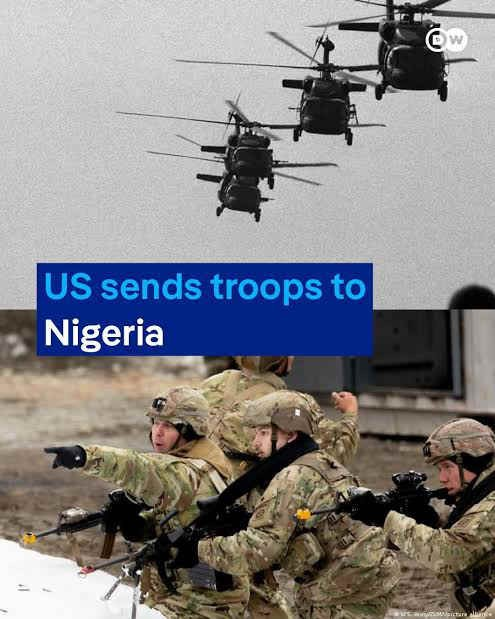
The United States is preparing to deploy about 200 military personnel to Nigeria as part of a renewed effort to support the country’s fight against Islamist militants, a U.S. official confirmed on Tuesday.
The troops are expected to focus on training and advisory roles for Nigerian security forces battling insurgent groups that have plagued parts of the country for more than a decade.
The planned deployment comes just weeks after U.S. President Donald Trump ordered airstrikes on what he described as Islamic State targets in Nigeria, marking a significant escalation in Washington’s direct military involvement in West Africa’s most populous nation. It also follows the U.S. military’s acknowledgment last week that a small team of American troops had already been sent to Nigeria, though officials at the time did not disclose their number. That admission was the first public confirmation of U.S. forces on Nigerian soil since the Christmas Day airstrikes.
According to the U.S. official, the additional 200 troops will supplement a limited contingent of American military personnel already operating in the country. Their primary mission will be to help train, advise, and support Nigerian forces as they confront Boko Haram and the Islamic State West Africa Province (ISWAP), two extremist groups that have carried out deadly attacks on civilians and military targets.
While the U.S. Africa Command (AFRICOM) did not immediately respond to requests for comment, the deployment aligns with broader U.S. security interests in the region. President Trump has previously indicated that further U.S. military action in Nigeria remains a possibility, signaling Washington’s growing concern over the deteriorating security situation in parts of the country.
Reuters has also reported that the United States has been conducting surveillance flights over Nigeria from neighboring Ghana since at least late November. These intelligence-gathering missions are believed to be aimed at monitoring militant movements and identifying potential targets, particularly in areas where Nigerian forces have struggled to maintain control.The decision to send more U.S. troops comes amid mounting pressure from Washington on Abuja to step up efforts against militant violence. President Trump has publicly accused Nigeria of failing to adequately protect Christian communities from Islamist attacks, especially in the country’s northwest. Those remarks sparked diplomatic tension, with Nigerian officials strongly rejecting claims of religious persecution.
The Nigerian government has consistently denied allegations of systematic targeting of Christians, insisting that security operations are directed at armed groups regardless of religion. Officials maintain that both Christians and Muslims have been victims of violence carried out by Islamist militants, bandits, and criminal gangs operating across several regions.
Nigeria has been grappling with a complex security crisis, particularly in the northeast and northwest. Boko Haram and its offshoot, ISWAP, have intensified attacks on military convoys, rural communities, and critical infrastructure in recent months. The northwest, in particular, has emerged as a major hotspot, combining elements of Islamist insurgency with widespread banditry, kidnappings, and communal violence.
The insurgency, which began more than 17 years ago, has claimed tens of thousands of lives and displaced millions of people, creating one of the world’s most severe humanitarian crises. Despite years of military operations and international support, militant groups continue to adapt, launching coordinated assaults and exploiting weaknesses in local security structures.
Nigeria, Africa’s most populous nation with over 230 million people, is roughly evenly divided between Christians and Muslims. Christians are predominantly based in the southern regions, while Muslims are more concentrated in the north. This demographic balance has often made religious narratives particularly sensitive, with officials wary of framing the conflict in sectarian terms.
Security analysts say the arrival of additional U.S. troops could help improve the operational capacity of Nigerian forces, particularly through advanced training, intelligence sharing, and logistical support. However, they also caution that foreign military assistance alone is unlikely to resolve Nigeria’s deep-rooted security challenges without broader reforms, including improved governance, community engagement, and economic development in conflict-affected areas.
For now, the planned deployment underscores a deepening U.S.-Nigeria security partnership at a time when militant violence continues to threaten stability in West Africa. As the situation evolves, both governments are likely to face increased scrutiny over how the expanded military cooperation impacts security on the ground and the lives of ordinary Nigerians caught in the conflict